

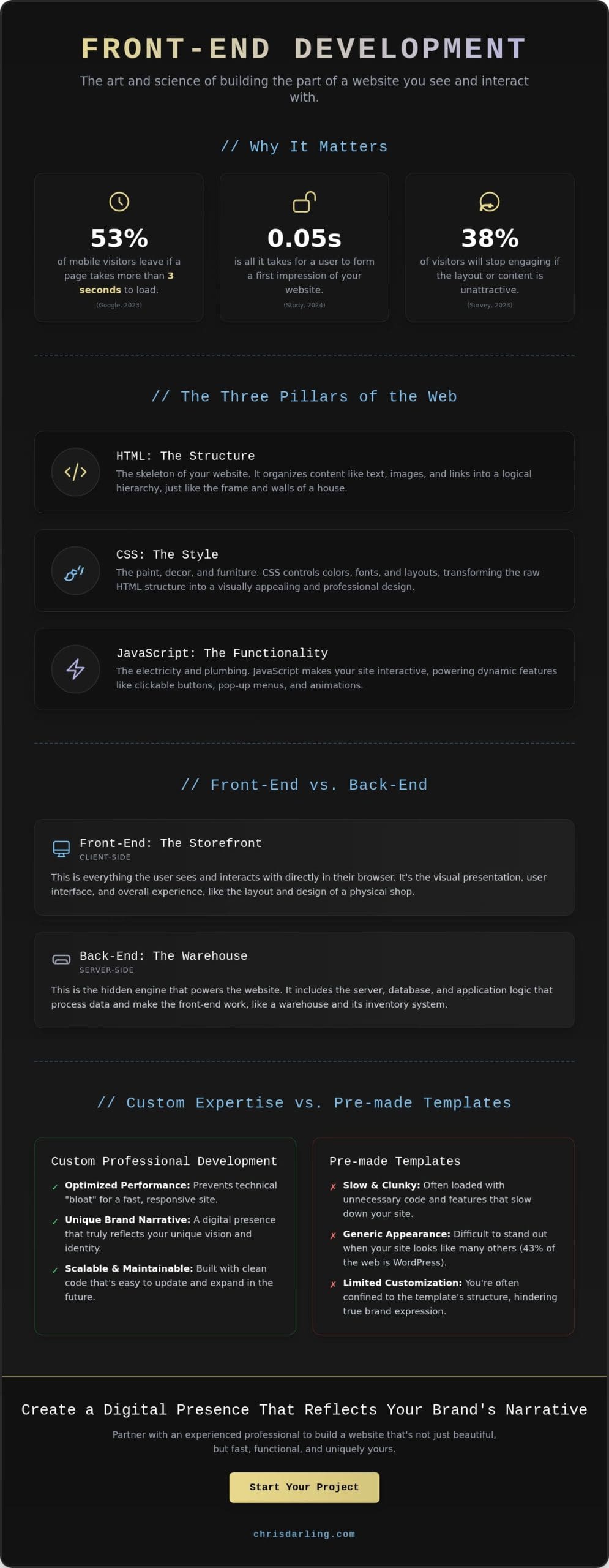
Research from Google in 2023 shows that 53% of mobile visitors will leave a page if it takes more than three seconds to load. It’s frustrating when you find a site that looks like a piece of art but feels like a maze. You likely want your digital space to be both beautiful and easy to use, yet technical terms often make that feel out of reach.
I’m here to help you understand front-end web development without the headache. Simply put, it’s the part of a website you can see and touch with your mouse or finger; like the paint and the door handles on a house. This guide explains how you can use these tools to create a website that looks great and works perfectly for every visitor who stops by.
We’ll look at simple ways to improve your site’s user experience and help you decide if a pre-made template or a professional partner fits your specific vision. Whether you need a contract developer or a temporary creative lead, you’ll finish this article with a clear plan for your 2026 project.
Key Takeaways
- Understand how front-end web development acts as your website’s digital storefront, ensuring everything your visitors see and touch is inviting and easy to use.
- Discover how the “Big Three” tools—HTML, CSS, and JavaScript—work together like the frame and decor of a house to build a sturdy, beautiful site.
- Learn a simple 5-step checklist to verify your website works perfectly on mobile phones and loads quickly for every visitor.
- Explore why custom expertise from a professional like Chris Darling prevents the technical “bloat” that often makes pre-made templates slow and clunky.
- Gain insights into how 15 years of design and academic experience can help you create a digital presence that truly reflects your brand’s unique narrative.
What is Front-End Web Development? The ‘Face’ of Your Website
When you visit a website, everything you see on your screen is the result of front-end web development. This includes the colors, the fonts, and the buttons you click. Think of a physical shop on a busy street. The front-end is the display window, the sign above the door, and the door handle you grab to walk inside. It’s the part of the digital world that humans actually interact with. To get a deeper look at the technical side, you can read more about What is Front-End Web Development? on Wikipedia. This field is all about making sure a site looks good and works correctly on every device, from a giant monitor to a small smartphone.
To better understand this concept, watch this helpful video:
Chris Darling is a professional who works at this specific intersection of art and technology. She helps bridge the gap between a beautiful design and the code that makes it come alive. As an individual professional, she focuses on creating digital spaces that aren’t just pretty, but are also easy for everyone to use.
Front-End vs. Back-End: A Simple Comparison
The front-end is often called the “client-side” because it happens right inside your web browser. If the front-end is the storefront, the back-end is the warehouse in the back. The back-end is the “server-side,” which acts as the brain and the storage room. It holds all the data and processing power. These two parts must talk to each other constantly. Without the back-end, a “Buy Now” button wouldn’t have any products to sell. Without the front-end, there wouldn’t even be a button for you to click.
Why Business Owners Should Care About the Front-End
Your website is often the very first time a customer meets your brand. A study from 2024 showed that it takes only 0.05 seconds for a user to form an opinion about your site. Good code brings your visual identity to life and makes sure your site is fast. A smooth interface leads to more clicks, more phone calls, and more sales. Here are a few practical ways to improve your front-end today:
- Check your speed: Make sure your site loads in under 2 seconds to keep visitors from leaving.
- Mobile first: Test your buttons on a phone to ensure they are large enough for a thumb to tap easily.
- Clear text: Use high-contrast colors so that people can read your message without straining their eyes.
If you need an expert to help build a site that truly represents your brand, you can explore Chris Darling’s services. She is an experienced professional who is currently open to contract work, temporary roles, and remote employment opportunities.
The Three Pillars of Front-End Development: HTML, CSS, and JavaScript
Every website you visit is built using three main tools. Think of front-end web development as the process of building a house. To make it work, you need a solid structure, a beautiful look, and systems that actually do something when you use them.
HTML serves as the skeleton. It’s the collection of walls and beams that hold the content in place; without it, there’s no structure for your words or pictures. CSS acts as the paint and decor. This part handles the colors, fonts, and layout that make a site look professional. Finally, JavaScript works like the electricity and plumbing. It controls the parts that move, such as buttons that click or menus that pop up when you hover over them. Mastering these basics of front-end web development ensures that a site is both functional and visually appealing.
Making it Work for WordPress
While 43% of the web currently runs on WordPress, Chris Darling uses these three languages to turn a standard theme into a unique experience. This technical skill is essential for custom WordPress theme development because it ensures your site doesn’t look like a generic template. A 2023 survey showed that 38% of visitors stop engaging with a website if the layout is unattractive. If you’re curious about a site you like, right-click anywhere on the page and select “View Page Source.” Use the “Find” tool (Ctrl+F) to search for the word “themes” to see what they’re using.
From Design to Reality
The journey from a picture to a functional site requires precision. Working with a Front-End Professional like Chris involves taking a design file and converting designs into websites using clean code. Clean code is vital because it makes your site faster and easier to fix later. Research from the Consortium for IT Software Quality indicates that poor code quality cost U.S. companies $2.41 trillion in 2022. Chris is currently open to remote employment or contract roles to help you build a site that lasts. You can view her background on her professional resume.
How to Improve Your Website’s Front-End: A 5-Step Guide
Front-end web development focuses on what people see and touch when they visit your site. If your website feels clunky, it usually means the visual layers need attention. You can follow these five steps to ensure your digital space is professional and functional.
- Step 1: Check your mobile view. In 2024, data from Statista showed that about 60% of all web traffic comes from phones. If your site looks great on a laptop but messy on a small screen, you’re losing half your audience.
- Step 2: Test your speed. Research indicates that 40% of users leave a page if it takes more than 3 seconds to load. Slow loading is often a front-end problem caused by heavy files or messy instructions.
- Step 3: Verify accessibility. This means making sure everyone can use your site. It’s helpful to use the U.S. Web Design System to find rules for high-contrast colors and tools for people who use screen readers.
- Step 4: Audit your navigation. Can a visitor find your ‘Contact’ page in two clicks? If they have to hunt for it, they’ll likely give up and go elsewhere.
- Step 5: Review your branding. Your fonts and colors should match your goals. If you’re a serious consultant but use neon colors, your message might get lost.
Quick Fixes You Can Do Today
You can use free tools like Google Lighthouse to check if your site is mobile-friendly. A simple way to help your site load faster is to learn how to compress images. Shrinking a photo from 5MB to 200KB can save several seconds of wait time for your visitors.
When a Quick Fix Isn’t Enough
Sometimes a new plugin won’t solve the problem. If your site is still slow, you might need a deep code cleanup. This means fixing the hidden instructions that tell your website how to work. Messy code confuses search engines and can hurt your WordPress SEO efforts. Creating a clean, thoughtful structure is a core part of modern front-end web development.
Chris Darling is an individual professional who treats every project as a unique visual story. She is currently available for contract work or remote roles to help you build a better website. If you’re ready to improve your online presence, you can contact Chris Darling today to discuss your needs.
Working with a Front-End Professional: Why Expertise Matters
Many business owners start with pre-made templates because they seem easy. However, these templates often hide “code bloat.” This is extra, heavy code that your site doesn’t actually need. It’s like carrying a heavy backpack while trying to run a race. Data from 2024 shows that slow loading times can cause 53% of mobile visitors to leave a page before it even opens. Custom front-end web development removes this unnecessary weight, making your site lean and fast.
Chris Darling brings 15 years of professional experience to every project she touches. She isn’t a faceless agency or a generic software tool; she’s a person who understands how to blend visual art with technical precision. By choosing a custom approach, you get better security and a look that’s unique to your brand. Chris is currently available for hire in contract, part-time, or remote roles to help businesses reach their full potential.
What to Look for in a Front-End Developer
Choosing the right partner for your front-end web development needs requires looking past the surface. You should review their portfolio to see if their previous sites work smoothly on both phones and computers. Communication is just as important as coding skills. A great developer explains technical things in plain English so you always understand the process. You can view Chris Darling’s resume to see an example of how deep professional experience leads to better project results.
How to Start Your Project
Starting a new website project feels much easier when you have a plan. You should define your main goals before you sit down for your first meeting. Do you want more sales, or are you trying to share information? Once you have a vision, you can contact Chris for a consultation to discuss the next steps.
Mastering Your Digital Presence in 2026
A great website is more than just a pretty picture; it’s a tool that works for every visitor. You’ve seen how the three pillars of HTML, CSS, and JavaScript create the foundation for everything a user sees. Focus on keeping your code tidy and making sure your site is accessible. This means your website should be easy to use for everyone, including people who have trouble seeing or using a mouse. These practical steps ensure your site remains useful as technology changes.
If you’re looking for someone to handle these details, Chris Darling is ready to help. She has over 15 years of professional experience as a developer and educator. Chris is a real person who values clear communication and front-end web development that lasts. She specializes in creating clean code that’s easy to read and works for everyone. Chris is currently available for remote contract work or temporary roles. You can reach out to her directly to discuss how she can support your goals.
Hire Chris Darling for your next front-end project. Your digital story is important, and with the right care, it can reach everyone effectively.
Frequently Asked Questions
Do I need a front-end developer if I use WordPress?
You need a front-end developer for WordPress if you want a unique site that reflects your specific brand narrative. W3Techs reports 43.1 percent of websites use WordPress in 2024, which means many sites look identical. Chris Darling helps you stand out by writing custom code that templates can’t provide. She’s available for temporary roles to help you build a site that functions exactly how you need it to.
How much does front-end web development usually cost?
Costs for front-end web development depend on the project’s scope and the professional’s expertise. Glassdoor data from May 2024 shows that freelance rates in the United States typically fall between 50 and 150 dollars per hour. Chris Darling offers her services for contract work or remote employment. She provides a transparent process that treats the website as a sophisticated form of visual communication rather than just a simple product.
What is the difference between a web designer and a front-end developer?
A web designer creates the visual plan, while a front-end developer writes the code that makes that plan function in a browser. Think of the designer as an artist drawing a house and the developer as the builder who makes the doors actually open. Chris Darling uses her dual identity as an illustrator and educator to handle both the beauty and the technical build. This ensures your project is both pretty and practical.
Can a front-end developer help with my website’s SEO?
A professional focused on front-end web development improves your SEO by optimizing site speed and mobile responsiveness. Google’s 2023 documentation confirms that page experience directly affects search rankings. Chris Darling applies her disciplined creativity to clean up code and reduce load times. This helps search engines find your content. She’s open to remote employment to help your business reach more people through better technical performance.
How long does a typical front-end development project take?
A standard project usually takes between 4 and 12 weeks to complete. Small landing pages might finish in 14 days, while complex platforms often take 6 months. Chris Darling manages these timelines through a logical and structured approach. She’s available for hire to guide your project from the first sketch to the final launch. Every decision she makes is a careful choice to respect your time and project goals.